Your diagnosis may be right. Your treatment plan may be incomplete.
If your treatment isn't delivering results, your genetic subtype may explain why. Most diagnoses identify the condition — fewer identify the subtype that determines which treatment actually works. Knowing yours gives your doctor a clearer path forward.
Many conditions have subtypes that respond to different treatments. Knowing yours changes the plan.
If your condition has been diagnosed but your treatment isn't working, the genetic subtype may explain why. These are areas where subtype identification most commonly changes the clinical approach.
Same diagnosis, different treatment paths.
Lung cancer alone has 27+ recognized subtypes. EGFR-mutated, ALK-rearranged, and KRAS-mutated tumors require entirely different drug classes. Treatment optimized for one subtype may be ineffective for another.
Explore conditions →The subtype shapes which medications work.
Epilepsy has 75+ recognized subtypes. SCN1A mutations (Dravet syndrome) respond differently to sodium channel blockers than other forms. Knowing the subtype is clinically critical.
Explore conditions →Different variants, different protocols.
LMNA, MYH7, and SCN5A cardiomyopathy variants carry different prognoses and treatment protocols. The variant determines the clinical plan.
Explore conditions →Your genome affects how medications work.
132 drugs across 14 categories have known genetic interactions — including 46 psychiatric medications. Your genome helps determine which are most likely to work.
Explore conditions →If you or a loved one has been diagnosed with cancer
Cancer treatment decisions involve a different clinical pathway — guided by our oncology team, who coordinate tumor profiling and treatment targets directly with your doctor.
See our oncology program →"They never added the numbers up until now when they saw the Dante Labs report." — Thomas, Dante Labs patient
Forty years of uncertainty. One test.
A patient had spent decades in the UK healthcare system without a diagnosis. Dante data, accepted by NHS clinical teams at Queen Elizabeth University Hospital Glasgow, identified Noonan Syndrome and a RUNX1 leukemia-associated variant that had gone undetected. After 40 years, they finally had an answer.
A complete read delivers a complete picture.
A patient came to Dante to investigate periodic paralysis. Reading the complete genome identified a concurrent hereditary cardiac finding — Brugada syndrome — that their doctor confirmed with an ECG. The result also explained a family member's unresolved cardiac history. One test. Every answer in it.
Twenty years old. Years of conflicting opinions. One answer.
Angela had spent years navigating conflicting medical opinions with no clear diagnosis. Standard tests had not identified a cause. Dante Genome Test identified a rare genetic variant that explained her symptoms — giving her and her medical team the clarity to move forward with an informed care plan.
What sequencing your entire genome actually means.
Standard hereditary screening panels cover the most commonly studied genes. A Mayo Clinic study in JAMA Oncology found that standard testing guidelines missed more than half of patients with inherited mutations.
Your full DNA (not just a part of it)
Traditional genetic testing looks at narrow sets of genes, missing most parts of your genome. We sequence your full genome — every gene and every region between genes.
Comprehensive insights and specialized reports
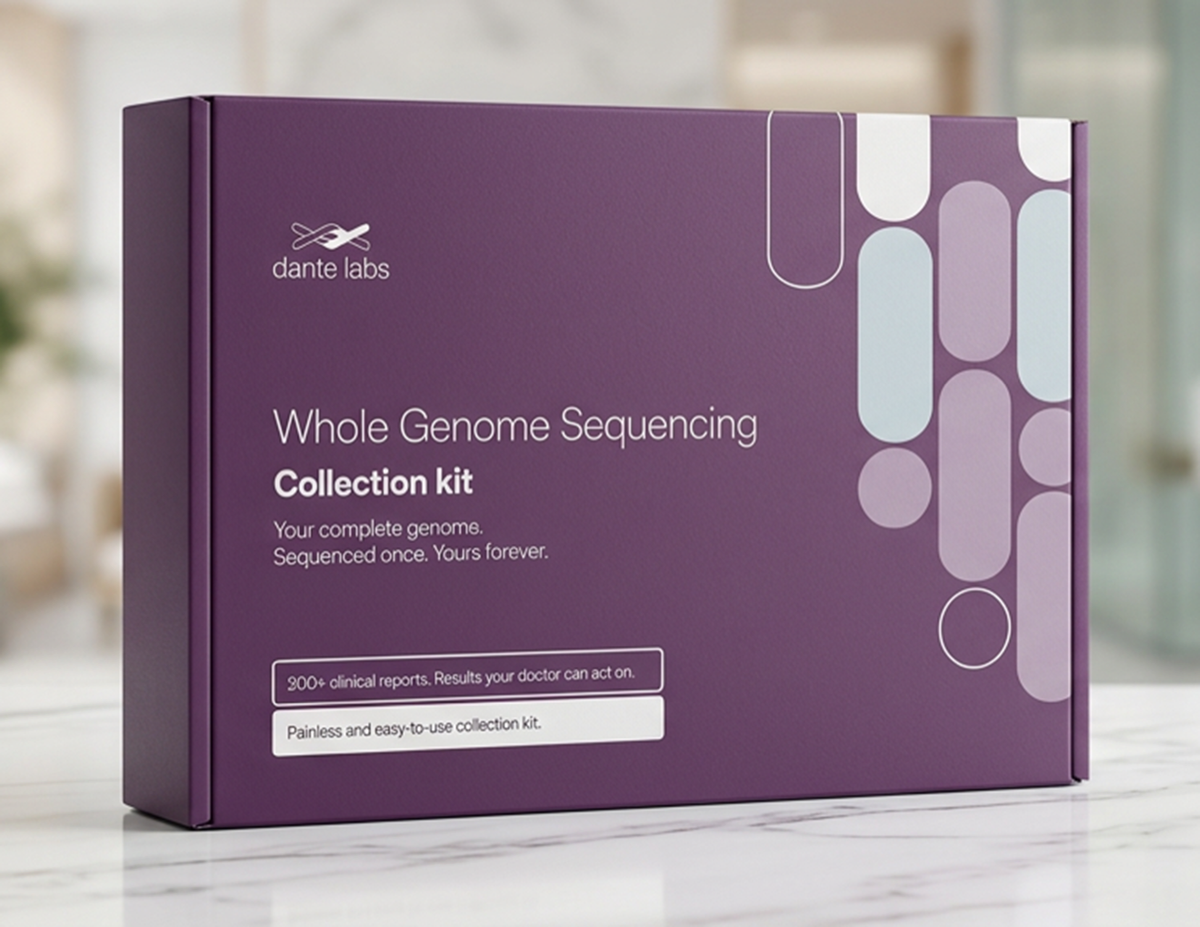
Easy to read and with answers you and your doctor can act on. Not a file to interpret – 200+ clinical reports, organized by category.
Your test becomes more valuable every year
Your DNA does not change, but genome science is accelerating. Every month, new variant-disease associations are discovered. We validate these findings and update your reports automatically. Your test becomes more valuable every year.
Clinical-grade results. Chosen by individuals, trusted by doctors for their most complex cases.
Accredited by & published in
Four steps to get started.
No clinic visit required.
Order your kit
Ships within 2 business days. Free delivery worldwide.
Collect your sample
Simple saliva collection at home. Takes 5 minutes. Everything you need is in the kit.
Send it back
Pre-paid return label included. Drop it in any post box.
Access your results
Reports delivered to your Genome Manager in 6–8 weeks. Review every finding, ask questions, and share directly with your physician. Your data is stored permanently.
Find your genetic subtype.
One test. Your entire genome sequenced at the clinical standard used for diagnostic decisions. 200+ physician-ready reports delivered to your Genome Manager in 6–8 weeks — including pharmacogenomic variants that may explain your treatment response.
Ships within 48 hours · Results in 6–8 weeks
Already diagnosed with cancer? Our oncology team guides a different process.
Speak with our oncology team